

Most creators are building houses of cards. Here’s how to build a fortress instead
Walk into any conversation about creator burnout, and you’ll hear the same story: “I’m posting every day, but I’m one bad month away from collapse.”
The problem isn’t work ethic. It’s architecture.
Most creators are building on a foundation of hope and hustle—posting content, praying for virality, and burning out when the algorithm gods stop smiling. They’re constructing elaborate houses of cards, adding more floors while the foundation crumbles beneath them.
A sustainable media empire isn’t built on luck or grind. It’s built on five interconnected pillars that support each other, creating a structure that can weather algorithm changes, market shifts, and personal emergencies without collapsing.
This is the architecture that separates creators who flame out in 18 months from those who build decade-spanning empires.
The Architecture of Longevity
Think of your creator business as a building. Most creators focus on making the facade impressive—the content that gets views, the posts that go viral, the subscriber counts that impress. But a beautiful facade means nothing if the structure behind it is unstable.
The Five Pillars system creates structural integrity. Each pillar serves a distinct function, and together they create something far more powerful than the sum of their parts.
Here’s how they work:
Pillar 1: The Content Engine
What It Does
This is your creative production system—the machinery that consistently generates valuable content without destroying you in the process.
Notice we said “engine,” not “effort.” Most creators treat content creation as an act of daily heroism. They sit down each day to stare at a blank page, hoping inspiration strikes. That’s not a system. That’s a recipe for burnout.
A Content Engine is a repeatable process that turns ideas into published content efficiently and consistently. It’s the difference between being a creator and having a creator business.
How It Connects
Your Content Engine feeds every other pillar. It attracts your Owned Audience. It demonstrates the value of your Product Ecosystem. It builds your Community Infrastructure. And it only becomes sustainable when supported by Systems & Automation.
Quick Tips
Tip 1: Build a Content Bank Never create content in real-time for publishing. Build a buffer. Batch-create content in focused sessions (e.g., one day a month for all your YouTube videos), then schedule it. Your goal: always have at least 2-4 weeks of content ready to publish.
Tip 2: Create from Patterns, Not Inspiration Develop 5-7 content frameworks that work for your audience, then fill them with different topics. For example: “How to X without Y,” “The 3 biggest mistakes in [topic],” “Case study: How [person] achieved [result].” These patterns make creation 10x faster.
Pillar 2: The Owned Audience
What It Does
This is your direct connection to the people who value your work—the audience you actually control, independent of any platform or algorithm.
Your Owned Audience consists of people who’ve given you permission to reach them directly: email subscribers, community members, customers. These are the people you can communicate with regardless of what any social media platform decides to do.
This is the most valuable asset in your entire business. Everything else can be rebuilt, but rebuilding an audience from zero is brutally difficult.
How It Connects
Your Content Engine feeds your Owned Audience (by attracting new subscribers and keeping existing ones engaged). Your Owned Audience enables your Product Ecosystem (they’re your buyers). They form the core of your Community Infrastructure. And Systems & Automation helps you serve them at scale.
Quick Tips
Tip 1: Track the Conversion Ratio Measure how many social media followers convert to owned audience members (email subscribers, community members, customers). If this ratio is below 5%, your conversion mechanism is broken. Most successful creators convert 10-20% over time.
Tip 2: Segment Early Not everyone in your audience wants the same thing. Tag subscribers based on interests, engagement level, and purchase behavior from the beginning. This allows you to send relevant content instead of generic broadcasts, dramatically improving retention.
Pillar 3: The Product Ecosystem
What It Does
This is your monetization infrastructure—the suite of offers that turn attention into revenue without requiring you to trade hours for dollars.
A Product Ecosystem isn’t a single course or service. It’s a range of offers at different price points that serve your audience at different stages of their journey. It allows someone to enter at $10 or $10,000, depending on their needs and readiness.
Most creators think they need one big product. Wrong. You need a product ladder: multiple offers that guide people from “just discovered you” to “would invest five figures to work with you.”
How It Connects
Your Content Engine demonstrates your expertise and creates demand for your products. Your Owned Audience provides the people who actually buy. Your Community Infrastructure creates the environment where products sell naturally. And Systems & Automation handles fulfillment and delivery without consuming your time.
Quick Tips
Tip 1: Build the Ladder Create offers at multiple price points: Entry ($0-50), Mid-tier ($100-500), Premium ($1,000-5,000), Elite ($5,000+). This lets you serve different segments and maximizes lifetime value. Someone who buys your $29 template might be your $5,000 consulting client next year.
Tip 2: Start with Templates and Frameworks Your first product shouldn’t be a course. It should be something you’ve already created for your own use: a template, checklist, framework, or tool. These are faster to create, easier to sell, and validate whether your audience will actually pay you before you invest in larger products.
Pillar 4: The Community Infrastructure
What It Does
This is the gathering place where your audience transforms from passive consumers into active participants—and where superfans are born.
Community Infrastructure isn’t just a Discord server or Facebook group you start and forget. It’s the systems, rituals, and experiences that create belonging, connection, and shared identity among your audience.
This is where the magic happens. Community members buy more, stay longer, refer others, and become brand evangelists. They provide feedback, testimonials, and case studies. They transform your business from “me talking to you” to “us building something together.”
How It Connects
Your Content Engine provides conversation starters and shared experiences for the community. Your Owned Audience supplies community members. Your Product Ecosystem creates different tiers of access (free community, paid membership, VIP circles). And Systems & Automation keeps the community running without requiring you to be online 24/7.
Quick Tips
Tip 1: Design for Rituals Communities die from neglect and lack of structure. Create regular rituals: weekly challenges, monthly AMAs, quarterly events. These create rhythm and give people reasons to return. Even a simple “Monday wins thread” can create powerful consistency.
Tip 2: Empower Member Leadership You can’t scale yourself, but you can scale leadership. Identify active members and give them roles, recognition, and responsibility. Community moderators, challenge hosts, welcome ambassadors—distributed leadership makes communities thrive while reducing your personal load.
Pillar 5: Systems & Automation
What It Does
This is the operational backbone that lets everything else scale without scaling your personal involvement proportionally.
Systems & Automation is what separates a creator job from a creator business. It’s the infrastructure that handles repetitive tasks, fulfills products, onboards customers, nurtures leads, and keeps operations running while you sleep (or vacation, or take a sick day).
Without this pillar, the other four collapse under their own weight. You become the bottleneck in your own business, working harder as you grow instead of working smarter.
How It Connects
This pillar supports all the others:
- It schedules and publishes your Content Engine output
- It nurtures and segments your Owned Audience automatically
- It delivers your Product Ecosystem without manual fulfillment
- It moderates and maintains your Community Infrastructure
- It frees you to work ON the business instead of IN it
Quick Tips
Tip 1: Automate the Redundant, Personalize the Meaningful Not everything should be automated. Automate: scheduling, email sequences, payment processing, basic customer support, content distribution. Keep personal: strategic decisions, high-value relationships, creative work, complex problem-solving.
Tip 2: Build Systems Before You Need Them The time to build a system is when things are manageable, not when you’re drowning. If you find yourself doing the same task three times, that’s your signal to systemize it. Use the “document while doing” method: record yourself doing a task once, then turn that into a checklist or SOP.
How the Pillars Work Together: The Flywheel Effect
Here’s where it gets powerful. These pillars aren’t separate—they’re interconnected in a reinforcing loop:
The Cycle:
- Your Content Engine attracts attention and demonstrates value
- This grows your Owned Audience (email list, community members)
- Your Owned Audience becomes customers in your Product Ecosystem
- Customers and engaged audience members join your Community Infrastructure
- Community members provide feedback, testimonials, and content ideas
- These ideas fuel your Content Engine with better, more relevant material
- Systems & Automation supports everything, making each pillar more efficient
- Efficiency creates space to improve each pillar, strengthening the entire structure
Each pillar makes the others more effective. Your content becomes better because your community tells you what they need. Your products sell more easily because your community creates social proof. Your audience grows faster because your systems ensure consistent, quality delivery.
This is how you build a media empire that compounds over time rather than requiring linear effort.
The Visual Framework
                    SUSTAINABLE MEDIA EMPIRE

                    ┌─────────────────────┐
                    │   CONTENT ENGINE    │
                    │   (Production &     │
                    │    Distribution)    │
                    └──────────┬──────────┘
                               │
                    ┌──────────▼──────────┐
                    │   OWNED AUDIENCE    │
                    │  (Direct Connection)│
                    └──────────┬──────────┘
                               │
         ┌─────────────────────┼─────────────────────┐
         │                     │                     │
┌────────▼────────┐   ┌────────▼────────┐   ┌───────▼────────┐
│    PRODUCT      │   │    COMMUNITY    │   │   SYSTEMS &    │
│   ECOSYSTEM     │◄──┤  INFRASTRUCTURE │──►│   AUTOMATION   │
│  (Monetization) │   │   (Engagement)  │   │  (Operations)  │
└─────────────────┘   └─────────────────┘   └────────────────┘
         │                     │                     │
         └─────────────────────┴─────────────────────┘
                               │
                    ┌──────────▼──────────┐
                    │    REINFORCING      │
                    │      FLYWHEEL       │
                    └─────────────────────┘
The Self-Assessment: Where Are Your Weak Points?
Rate each pillar in your current creator business (1-10):
Content Engine: ___ / 10
- Do you have a systematic process for generating content?
- Can you take a two-week break without your content pipeline stopping?
- Do you have at least 2-4 weeks of content buffered?
Owned Audience: ___ / 10
- What percentage of your social followers are on your email list?
- Could you survive if your largest platform banned you tomorrow?
- Do you communicate directly with your audience at least weekly?
Product Ecosystem: ___ / 10
- Do you have offers at multiple price points?
- Can your audience buy from you without your direct involvement?
- Is at least 50% of your revenue from products/services you control?
Community Infrastructure: ___ / 10
- Do you have a dedicated space where your audience gathers?
- Are community members interacting with each other, not just you?
- Does your community have regular rituals and events?
Systems & Automation: ___ / 10
- Could your business run for a week without your daily involvement?
- Are repetitive tasks automated?
- Do you have documented processes for key operations?
Your lowest-scoring pillar is your biggest vulnerability. That’s where collapse will start when pressure hits. The good news? Now you know exactly where to focus your efforts.
Building Your Empire: The 90-Day Blueprint
You don’t need to build all five pillars simultaneously. Here’s the priority order:
Phase 1 (Days 1-30): Content Engine + Owned Audience Focus on creating a reliable content production system and capturing your audience in owned channels. Without these, nothing else matters.
Phase 2 (Days 31-60): Product Ecosystem Once you have consistent content and a growing email list, create your first offers. Start simple: a template, guide, or small product that validates whether people will pay you.
Phase 3 (Days 61-90): Community Infrastructure + Systems With revenue coming in, invest in building community and automation. These multiply the effectiveness of everything you’ve already built.
Each phase builds on the previous. You can’t automate what doesn’t exist. You can’t build community around products no one wants. You can’t sell products to an audience you don’t own.
But build in the right order, and each pillar reinforces the next.
The Empire Mindset
The difference between a creator and a media empire isn’t size—it’s structure.
You don’t need millions of followers to build something sustainable. You need solid architecture. A 10,000-person email list with all five pillars will outperform a 1,000,000-follower social media account with none.
Most creators are focused on growing bigger. They should be focused on building stronger.
When you have all five pillars in place:
- Algorithm changes become inconvenient, not catastrophic
- You can take breaks without your income disappearing
- Your business grows more valuable over time, not more fragile
- You’re building an asset you can sell, not a job you’re trapped in
- You sleep better at night
This is what separates flash-in-the-pan creators from decade-long empires.
The Full Architectural Manual
This article gives you the overview—the 30,000-foot view of what a sustainable media empire looks like. But understanding the framework is different from executing it.
The complete architectural manual includes:
- Detailed implementation plans for each pillar
- Templates, checklists, and frameworks for every component
- Case studies of creators who’ve built successful five-pillar businesses
- Troubleshooting guides for common failure points
- Integration strategies for making the pillars work together seamlessly
- Scaling playbooks for taking each pillar from basic to advanced
Building a media empire isn’t about working harder. It’s about building smarter—creating a structure that supports your creativity instead of consuming it.
The five pillars give you that structure. The question is: Are you ready to build something that lasts?
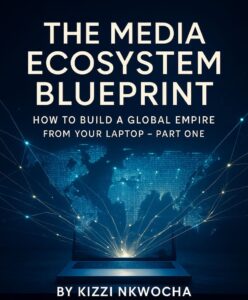 Need to learn more about the five pillars? Pick up a copy of The Media Ecosystem Blueprint: How to Build a Global Empire from Your Laptop .
Build influence, wealth, and impact — one interconnected media asset at a time.
The world of traditional media has collapsed. The old gatekeepers are gone. Today, a single person with a laptop and a vision can build a global media empire — if they understand how to create an ecosystem where every part supports the whole.
In The Media Ecosystem Blueprint, Kizzi Nkwocha reveals the strategy he used to turn digital magazines, books, awards, and online platforms into a powerful, self-reinforcing network that generates lasting visibility and income.
You’ll discover how to design, launch, and scale your own interconnected media universe — one where your articles, podcasts, videos, and social platforms all feed, support, and amplify each other.
Inside this groundbreaking guide, you’ll learn how to:
- Recognize why traditional media models are collapsing — and how to thrive in the new digital order
- Adopt the ecosystem mindset that empowers modern creators and business leaders
- Architect your own media network that grows organically and supports multiple income streams
- Build a sustainable content engine that attracts audiences and partners for life
- Define your North Star vision — the purpose that keeps your empire aligned and profitable
Whether you’re an entrepreneur, publisher, influencer, or creative visionary, this book will show you how to transform your scattered ideas and assets into a unified, scalable ecosystem that works for you 24/7.
The future of media isn’t about platforms — it’s about ecosystems.
And your global empire starts here.
The Viewfinder: What’s Your Take?
How do you feel about this article?